Friday, June 22, 2007

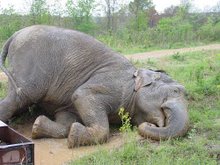
Dulary loves to balance rocks on the top of her head
as she wanders around her new surroundings.

R.I.P MONA

Photo Sharing<a href=

SO SORRY! WHERE TO LATE!

RIP BIG ONE SO SORRY I HOPE THEIR IS A HAVEN FOR YOU!

RIP: Mona the Elephant
After 59 years on her toes, Mona, the Birmingham Zoo’s Asian elephant, died early this morning surrounded by her human herd, the zoo keepers and staff, some of whom have taken care of her for more than 20 years.Mona arrived at the Birmingham Zoo in 1955, and was one of the oldest elephants in North America. According to a study published in the journal Zoo Biology, the average life span of female Asian elephants in North American zoological facilites is 44.8 years. That same study found that the life expectancies of elephants in zoos are consistent with elephants in the wild.
Last Monday, Mona had difficulty standing, and it took dozens of veterinarians, zookeepers and staff and a crane to get the 8,000-pound beauty back on her feet. Anticipating further age-related complications, the zoo staff made the difficult decision to euthanize her.
“This is an immense loss for the staff and those that love Mona,” says Birmingham Zoo CEO Dr. William Foster. “Mona delighted three generations of Zoo visitors about her species. She lived a long and fulfilling life, a tribute to the staff and diligent care provided to her.”
Mona loved to paint and play musical instruments. Her favorite snack was marshmallow Peeps, but she also favored Altoids and peanuts.
— Glenny Brock

-->
K. Whitmire Jun 21st 2007 01:59 pm News, R.I.P. 4 Comments Trackback URI Comments RSS

LET HER GO TO SANCTUARY NOW SHE HAS GIVEN YOU HER ENTIRE LIFE 60YRS


Birmingham Zoo elephant has to be lifted to her feet
Posted by Birmingham News staff June 18, 2007 1:02 PM
Staff and vets used slings this morning to help raise the Birmingham Zoo's remaining elephant to her feet.

Mona, a nearly 60-year-old, 8,000-pound elephant, was found off her feet and unable to stand this morning, said Katrina Cade, vice president of marketing.

Thursday, June 21, 2007

MANS BEST FRIEND MUTILATED

Man’s best friend mutilated By Jon Johnson, Assistant Editor
It has been said that man’s best friend is his dog. Faithful and loyal, dogs have been man’s companion for more than 15,000 years.In that time, dogs have earned a unique position with their human counterparts, essentially becoming a part of the family.

The Graham County Sheriff’s Office responded to a call in reference to animal cruelty in the Roper Lake area June 2 and discovered a homeowner’s dog’s paws had been shot off.According to the GCSO police report, the homeowner initially thought his dogs had been caught in some sort of trap, but after being cared for by a veterinarian, an X-ray showed the injuries were caused by a birdshot shell from a small caliber gun.The owner of the dogs feels this was especially cruel because one of them had only three legs before he was shot.“It cost $2,000 to amputate the (injured) leg off each dog,” he said. “The one only has two legs, both on his left side. I’ll probably have to put him to sleep.”While the GCSO has no suspects at this time, it believes the shooter may have been on an ATV or motorcycle.The homeowner has offered a $100 reward for any information that leads to the arrest and conviction of the individual or individuals who perpetrated the crime. Call the Graham County Sheriff’s Office at 428-3141.

Tuesday, June 19, 2007

KITTEN TIED TO TRACKS SAD!!!!!!

SAN ANTONIO, June 16 Two security guards in Texas rescued a flea-bitten kitten from an unpleasant death on the railroad tracks at the hands of a young couple.John Hernandez and Jacob Salinas told The San Antonio Express-News they spotted the couple with the kitten early Thursday. After the couple left, Hernandez and Salinas said they found the kitten with its hind legs tied to the tracks."It was disgusting, really, seeing someone tie a kitten to the tracks, just for the joy of seeing it get run over," Salinas. After rescuing the young calico, which appeared to be starving, the two men caught up with the couple, who were in a car. They said they backed off when the male half of the couple got a gun out of the trunk.Hernandez has given the cat a home, at least temporarily, and is trying to fatten it up.Police are seeking the couple, who could face animal cruelty charges, and possibly other charges, for threatening the cat rescuers.Copyright 2007 by UPI
» Print this article» Email this article (Click Here)

Thursday, June 14, 2007


-----------------

"A Pit Bull Who Provided Lessons in Loyalty & Unfailing Love" "A Pit Bull Who Provided Lessons in Loyalty & Unfailing Love"


In the pecking order of man and beast, there was no lower rung than the one shared by Randy Vargas and Foxy on the streets of Hoboken.

He was 46 and homeless, regular work like that fondly remembered machine-shop job long in the past. She was a member of dogdom's least-fashionable demographic, a 10-year-old brindled pit bull, compact as a pickup truck, ears askew, two-tone face, white neck, the rest an arbitrary mix of light and dark.

And yet in this city increasingly defined by creatures who drew the long straw — winners in real estate and on Wall Street, sleek goldens, pampered Yorkies, fashionable puggles and doodles — there was something transcendent in their bond.

Maybe in a world of opaque relationships, theirs was a lesson in clarity like a parable from the Bible. He had rescued her back when she was homeless and abused, a scared runty thing living with homeless men who had no use for her. She in turn gave him purpose and companionship and love.

Maybe it was how the relationship brought out the best in both. It brought him to life and into the world, as much a part of Hoboken street life as any young comer with his black Lab. And it made her a creature of eternal sweetness, unfailingly friendly to people and animals, tail wagging at the merest glance, a pit bull in name but not metaphor.

So if you spent any time in Hoboken the odds are pretty good you would have seen the two of them, sleeping in front of SS. Peter and Paul Parish Center, visiting the Hoboken Animal Hospital, walking down the street — the dog keeping perfect pace with him, dressed in winter in raffish layers of sweatshirts and T-shirts plucked from the St. Mary's Hospital Thrift Store, she keeping perfect pace with him.

Cheryl Lamoreaux remembered seeing Mr. Vargas resting on a condo's shaded concrete steps on a sweltering August weekend day, flat on his back with Foxy in the same position one step below. It was the perfect image of man and dog, she said, and added, "This really was a dog with a deep soul."

Everyone who knew them said the same thing: Mr. Vargas cared for the dog better than for himself.

"If it was the dead of winter, the dog would get all the blankets, he'd get the sidewalk with nothing on it," said Robin Murphy, a groomer at the Hoboken Animal Hospital. "If it was raining, he'd put the umbrella up for the dog before he'd put it up for himself."

But there's not much margin for error at the bottom rung. Once this winter, he was arrested, accused of making threatening remarks to women. The case was dismissed, and friends say it should never have gone that far. But Ms. Murphy had to rescue Foxy from the pound in Newark, where she could have been euthanized.

It all ended so fast, people still can't explain it. Aside from a dog run, she had seldom been seen off the leash, but on the morning of March 19 in the park, she was. She saw a dog she knew across Hudson Street, dashed across to say hello and was hit by a white pickup that stopped briefly and then sped off.

He held the dog, blood spurting from her mouth, and waved at passing cars, but none stopped. So he carried her 60 pounds, feeling the broken bones in his hand, as far as he could, then put her down and ran to the animal hospital for help. But it was too late.

People come by every day, some fighting back tears, to leave donations, more than $900 so far. Some come from people who knew them, most from people who felt like they did. Alone they might have been invisible. Together, they were impossible to miss.

In different ways, they're still around. Her picture is in some store windows, wearing a gray sweatshirt with a red T-shirt under it, gazing to the right like a sentry, a wondrous study in essence of dog with a touch of human thrown in. Since the accident Mr. Vargas has had good days and bad ones, sometimes being up and around, sometimes, like the other day, looking groggy and defeated under his red comforter on the street. "I feel," he told a friend, "like I have a hole in my soul."

At the animal hospital they're buying a pendant to hold some of her ashes that he can wear around his neck. Friends check on him regularly, bring him food, talk of finally getting him a place to live. There's talk of getting him a new dog when he's ready, which surely isn't now.

"It's like most relationships," he said from under the red blanket. "You have to wait for the right time."

MOST ALL ELEPHANTS USED IN THE CIRCUS HAVE T.B.

JUNE 12 2007

Contact:
Lisa Wathne 757-622-7382

Hugo, Okla. -- Today, PETA sent an urgent letter to Dr. Chester Gipson, deputy administrator of the U.S. Department of Agriculture’s (USDA) animal care division, urging him to immediately quarantine all elephants with the Carson & Barnes Circus. PETA is urging the action after learning from a reliable source that three Carson & Barnes elephants were allegedly quarantined last week. PETA suspects that this action was taken because the elephants may have been exposed to or infected with tuberculosis (T. PETA believes that if three elephants were exposed to TB, all the elephants traveling with the circus were potentially exposed and should be quarantined and tested.

Carson & Barnes has a history of shoddy monitoring of TB, including falsifying TB tests submitted on its elephants and failing to test elephant handlers for TB. Carson & Barnes also owns an elephant named Joy who was obtained from the Hawthorn Corporation, whose elephants the USDA has described as "a very real risk of tubercular contagion to the national elephant herd and the general public."

"TB is a highly contagious disease that can spread easily from elephant to elephant and from elephants to people," says PETA Director Debbie Leahy. "Sending a group of potentially infected elephants out to mingle with thousands of circusgoers makes the Andrew Speaker case look like a tempest in a teapot."

Wednesday, June 13, 2007

Poachers have shot the last two white rhinos in Zambia

Tue Jun 12, 9:56 AM ET
LUSAKA (AFP) - Poachers have shot the last two white rhinos in Zambia, killing one and wounding the other, in a night operation at the Mosi-Oa-Tunya national park in Livingstone, an official said Tuesday.

The shooting of the two endangered animals in a heavily-guarded zoological park near Victoria Falls in Zambia's tourist resort town of Livingstone took place last week.
"I can confirm that one of the white rhinos was shot dead by suspected poachers. The other one was wounded and is undergoing treatment," said Maureen Mwape, spokesperson of the Zambia Wildlife Authority (ZAWA), which would be investigating the shooting.
The dead female rhino's horn was apparently removed.
Zambia's white rhinos were all killed by poachers but the government managed to acquire six from South Africa in 1993, of which the injured male is the last to survive.

RINGLING BROS. AND BARNUM & BAILEY CIRCUS


ANIMALPROTECTIONINSTITUTE
Animals in the Circus: A Lifetime of Misery

Using animals in circuses is an unnecessary and inhumane practice that's harmful to both the animals and the public. Unlike the human performers who choose to work in circuses, exotic animals are forced to take part in the show. They are involuntary actors in a degrading, unnatural spectacle.
While many people associate the circus with "safe, wholesome, family fun" — an association promoted aggressively by the circus PR machine — the truth is much darker. Government inspection reports reveal ongoing mistreatment of animals in circuses, as well as failures to provide the basic minimal standards of care required by law. Animals used in circuses have been injured and killed, and have injured and killed humans.
Circuses that exploit animals make lofty claims about their "educational" value and their contributions to "conservation." But the real message that these circuses send to children is that it's acceptable to abuse animals for amusement and profit.

And the conservation claims made by many circuses are merely veiled attempts to justify the exploitation of animals for commercial gain. Endangered animals born in circus "conservation" programs have never been released into the wild — they are doomed, instead, to life in captivity.
API's circus campaign aims to end the exploitation of "performing" animals by educating both the public and key decision-makers about how animals suffer under the big top, and by pushing for legislation and policy changes that help stop circus cruelty. We are also involved in groundbreaking litigation against Ringling Bros. and Barnum & Bailey Circus for its mistreatment of elephants.
Next: Get The Facts »
Florida Residents: Take a Stand Against Circus Cruelty
Mississippi Residents: Take a Stand Against Circus Cruelty
Nevada Residents: Take a Stand Against Circus Cruelty
More Action Alerts »
Ten Fast Facts about Animals in the Circus
Exhibited & Circus Animal Incidents
Four Reasons Why You Should NEVER Attend a Circus that Uses Animals
More Facts »
2006 Circus Wrap-Up
Animals and the Law: Myths and Misconceptions
Taking on the Circus
More Articles »
Details Unsubscribe

Contact Us Site Map Terms of Use Privacy Policy Link To Us © 2003-2007 - The Animal Protection Institute - All rights reserved.
_uacct = "UA-1796677-1";
urchinTracker();

PET OF THE WEEK


PET OF THE WEEK [Photo]PeterPeter was born at the Humane Society on September 5, 2006 in Ginger Morgan’s office. Peter was one of six puppies born to Lola (a small German Shepherd). He and his siblings were all named after the kids on the Brady Bunch TV show.The Humane Society of Memphis and Shelby County is participating in a program at the Mark H. Luttrell Correctional Center called Puppies Achieving Worthy Service, or PAWS. Peter just completed six weeks of obedience training where the inmates taught him to sit, down, stay, walk on a loose leash, and a couple of cute tricks. Through this program the inmates get an opportunity to give back to society from behind bars. And the Humane Society gets a trained dog that is highly adoptable.Peter is 8 months old and weighs 62 lbs. He has been described as being a big dog with an even bigger heart.You can adopt Peter by visiting him at the Humane Society located at 935 Farm Road.